Table of Contents
- Why There’s No Single Right Number
- A Realistic Breakdown by Closet Type
- How Bin Size Actually Changes Your Count
- Common Mistakes That Inflate Your Bin Count
- The Better Question: What Are You Actually Storing?
- Signs You Have Too Many Storage Bins
- Signs You Need More (or Bigger) Storage Bins
- A 5-Minute Self-Check Before You Buy Anything
- Frequently Asked Questions
Quick answer: if you’re wondering how many storage bins a small closet actually needs, most closets (3-4 feet wide) need 4 to 6 storage bins total — typically 2-3 for shelving above the hanging rod, 1-2 for floor storage, and 1 for a catch-all of accessories. The exact number depends more on what’s going in the closet than the closet’s size, which is the part most “X bins per closet” guides skip entirely.
Why There’s No Single Right Number
A closet holding off-season clothes and extra linens needs fewer, larger bins. A closet holding shoes, accessories, bags, and seasonal decor needs more, smaller bins — same square footage, completely different bin count. Instead of a flat number, it’s more useful to count by category and work backward — a method professional organizers at NAPO also recommend over guessing a quantity upfront.
How Many Storage Bins by Closet Type: A Realistic Breakdown
| Closet Type | Typical Bin Count | What They Usually Hold |
|---|---|---|
| Small bedroom closet (3-4 ft) | 4-6 bins | Off-season clothes, shoes, accessories, extra linens |
| Walk-in closet | 8-12 bins | Shoes, bags, seasonal items, accessories, sentimental items |
| Linen closet | 3-5 bins | Sheets by size, towels, first-aid/extras, spare blankets |
| Hall/coat closet | 2-4 bins | Gloves/scarves/hats, shoe care items, umbrellas, seasonal gear |
How Bin Size Actually Changes Your Count
This is the part most guides skip entirely: the number of bins you need depends heavily on what size you’re buying, not just how many categories you have. A single 28-quart bin can absorb what would otherwise take three 10-quart bins, which means “how many bins” and “what size bins” are really the same question asked two different ways.
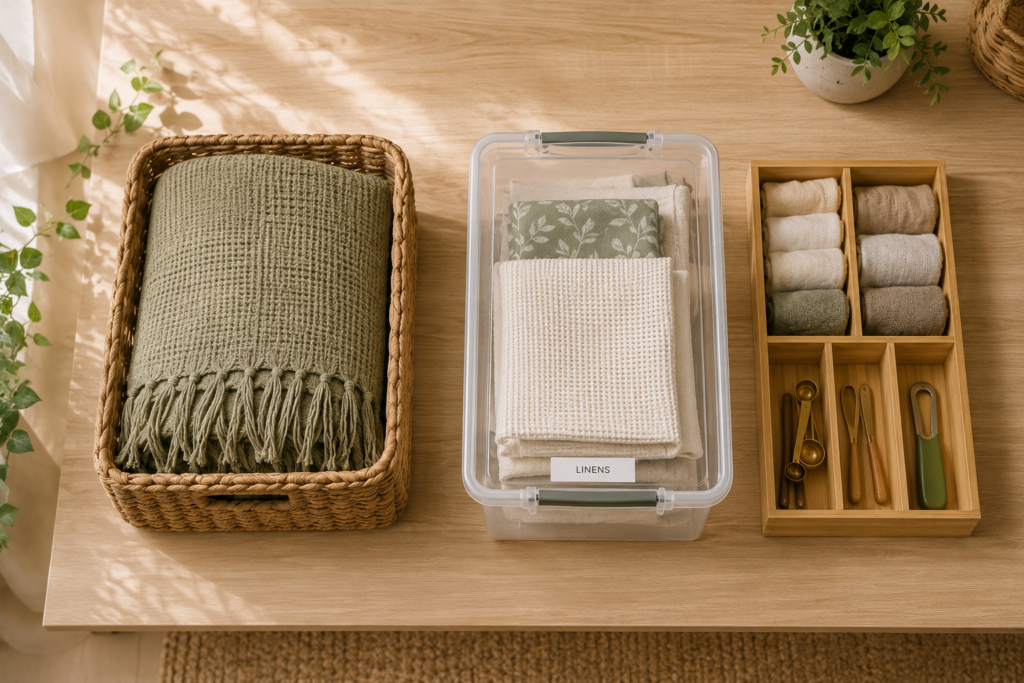
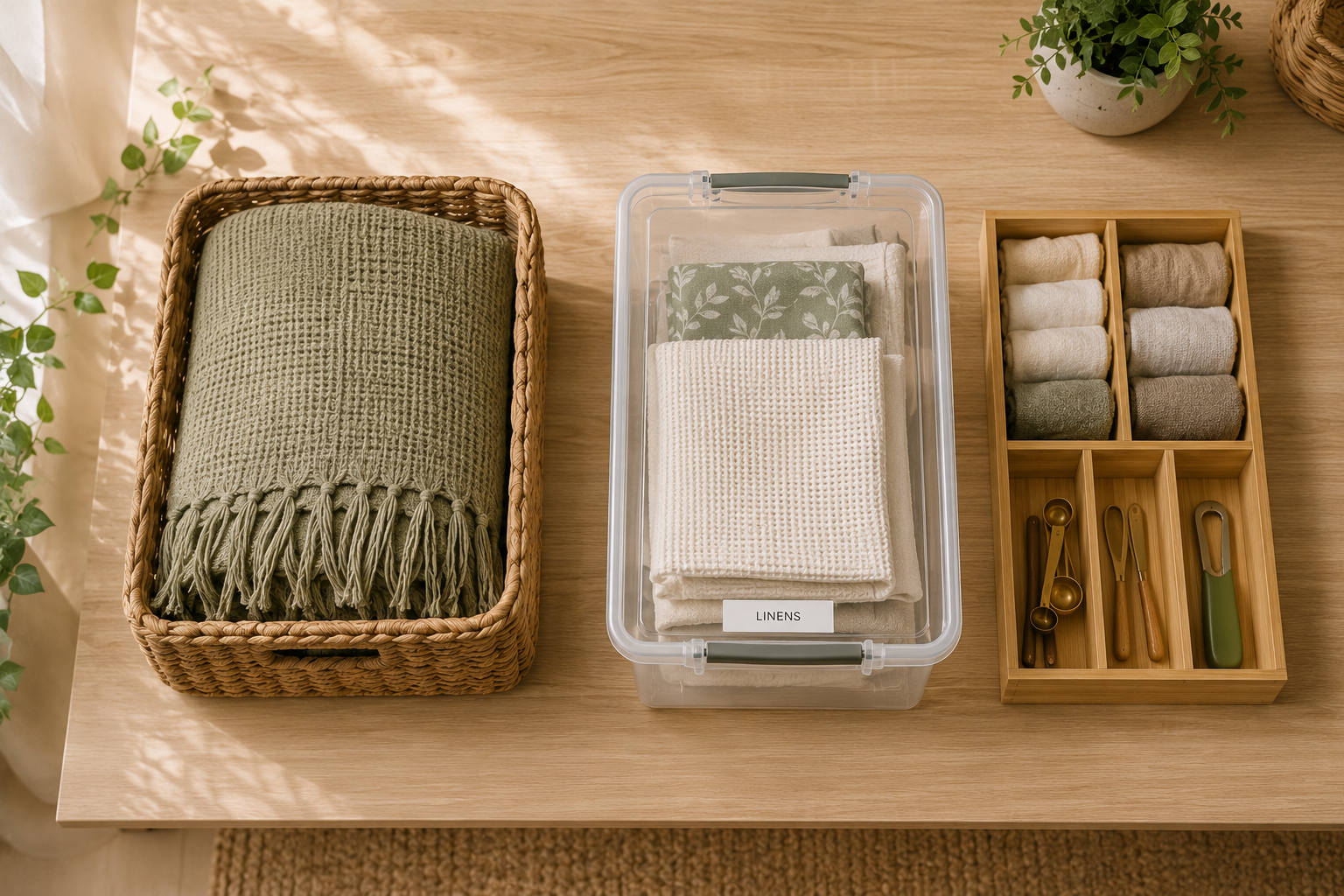
As a rough guide: small bins (6-10 quarts) suit single categories like gloves or chargers. Mid-size bins (12-16 quarts) handle most clothing or shoe categories. Large bins (20-28 quarts) work for bulkier items like blankets or out-of-season coats, but only if you have the shelf depth to actually fit them without overhanging the edge.
If you’re torn between buying four small bins or two large ones for the same closet, the small bins almost always win for day-to-day usability — you’re not hauling a heavy 28-quart bin down just to grab one scarf.
Common Mistakes That Inflate Your Bin Count
A few habits quietly push people toward buying far more bins than they need:
- Buying before sorting. Grabbing a set of bins at the store before you’ve actually gone through the closet means guessing at quantity, and guesses run high almost every time.
- One bin, one item type, no consolidation. A bin each for gloves, scarves, and hats can usually consolidate into one “cold weather accessories” bin instead of three.
- Keeping bins for things you should donate. If a bin exists mostly to store items you haven’re used in over a year, it’s not solving a storage problem — it’s storing a decision you haven’t made yet.
- Matching aesthetics over function. Buying a 12-piece matching bin set because it looks cohesive, regardless of whether you actually have 12 categories to fill them with.
Fixing the first habit alone — sorting before shopping — usually solves the other three on its own, since an accurate category count makes it obvious when you’re duplicating or overbuying.
The Better Question: What Are You Actually Storing?
Before buying any storage bins, sort what’s going into the closet into rough categories first — clothes, shoes, accessories, sentimental items, seasonal gear, everything else. Each distinct category that won’t fit neatly on a hanger or shelf on its own generally wants one bin. This naturally gives you a number that fits your actual stuff, instead of guessing a count and hoping it works out.
A good rule of thumb: if you’re unsure between two bin sizes, buy one size smaller than you think you need. Oversized bins almost always end up half-empty or get used as a dumping ground for things that should’ve been sorted or donated.
Signs You Have Too Many Storage Bins
- You have bins you can’t remember the contents of without opening them
- More than one bin is labeled “miscellaneous” or “other”
- You’re buying bins before deciding what’s staying versus being donated
Signs You Need More (or Bigger) Storage Bins
- Items are stacked loose on shelves and sliding around
- You’re using shopping bags or boxes as makeshift storage
- One bin is overflowing while everything else fits fine
Real Talk:
I once bought ten matching storage bins for a closet that needed maybe five. The other five sat stacked in the garage for months, then got donated unused — which is a little embarrassing for someone who runs a home organization blog. Sort first, count categories, then shop. Not the other way around.
If you haven’t sorted what’s actually staying in the closet yet, that’s the step worth doing first — before you buy a single bin. Our free decluttering checklist generator lets you build a closet-specific checklist in a couple of minutes, and our guide on decluttering your closet in one afternoon walks through the sorting process step by step.
A 5-Minute Self-Check Before You Buy Anything
Before adding bins to your cart, walk through this quickly:
- Open the closet and list every category currently inside it, out loud or on your phone — clothes, shoes, accessories, linens, sentimental items, whatever applies.
- Cross out anything that’s hanging or shelved fine on its own without a container.
- Count what remains. That number is roughly your bin count, give or take one or two for overflow.
- Measure your actual shelf depth and height before buying, not after — a bin that doesn’t fit the shelf is a bin you’ll be returning.
This takes longer to read than to actually do. Most people finish this check in under five minutes and walk away with a number that’s far more accurate than any generic “bins per closet” formula.
Frequently Asked Questions
What size bins work best for a small closet?
Mid-size bins (roughly 12-16 quarts) tend to fit standard closet shelving without wasting vertical space, and stay light enough to lift down comfortably when full.
Should bins be clear or solid-colored?
Clear bins are more functional since you can see contents without opening them u2014 useful for shelving you access often. Solid-colored or fabric bins work better for things you rarely need to see into, like off-season storage.
Is it better to have fewer large bins or more small ones?
More small bins sorted by category, generally. A single large bin holding five unrelated categories just becomes a place where things get lost u2014 the same problem the bin was supposed to solve.